How a teleprompter works
Every teleprompter achieves the same result through one of three mechanisms:
Beam splitter hardware rig. A half-silvered glass panel is mounted at a 45-degree angle in front of the camera lens. A monitor below the glass reflects the script text up through the glass toward the speaker. The speaker sees the text on the glass surface. The camera, positioned behind the glass, sees through it — the glass is transparent to the camera but reflective enough to show the text to the speaker. This is the setup used in broadcast studios, presidential podiums, and professional video productions.
Tablet or phone mount near the camera. A device running teleprompter software is mounted as close to the camera lens as possible — either directly below the lens on a tripod mount or on a bracket beside the camera. The speaker reads from the device screen. The closer the device is to the camera lens, the less obvious the eye-line offset. Most consumer teleprompter apps — Teleprompter Pro, BigVU, PromptSmart — use this approach.
Browser overlay on a webcam feed. For video calls and browser-based recording, the script is rendered as a transparent overlay on the speaker's camera feed. The speaker sees the text floating over their own image in their screen. Because the screen is also where the Zoom window and camera indicator are, reading the script and looking at the camera are the same direction. The overlay is visible only to the speaker — the audience receives the standard camera feed. SyncedCue uses this approach.
A brief history of the teleprompter
The first teleprompter was built by Hubert Schlafly in 1950 for a television soap opera called The First Hundred Years. Actors struggled to memorise lines for live television broadcasts, and Schlafly designed a motorised paper scroll mounted beside the camera to give them a visible script without requiring memorisation.
The device was patented as the TelePrompTer and quickly adopted by broadcast television. By the 1952 presidential election, both Eisenhower and Stevenson were using teleprompters for campaign speeches — the first political use of the technology.
The beam splitter design — which allowed the text to appear directly in front of the camera lens rather than beside it — was developed through the 1960s and became the standard for professional broadcast use.
Software teleprompters appeared with the first smartphones and tablets in the late 2000s. By 2015, apps like Teleprompter Pro and PromptSmart had replaced paper scrolls and hardware monitors for most non-broadcast uses.
Browser-based teleprompters — tools that run in a browser tab with no download — emerged as a significant category in the early 2020s, driven by the growth of remote video calls and content creation. The Zoom overlay method, which renders the script directly on a webcam feed, is the most recent development in the teleprompter's seventy-year evolution.
Who uses teleprompters
The common assumption is that teleprompters are professional broadcast equipment used only by news anchors and politicians. This is accurate about who invented them and who used them first. It is no longer accurate about who uses them.
Broadcast professionals — news anchors, sports presenters, weather reporters — read from teleprompters for every broadcast. The composed, authoritative delivery associated with broadcast journalism is in significant part a product of prepared, teleprompter-delivered scripts.
Politicians and executives — every major political address since the 1980s has been delivered from a teleprompter. The two glass panels flanking every US presidential podium are teleprompter screens. Corporate CEOs use them for earnings calls, all-hands meetings, and product launches.
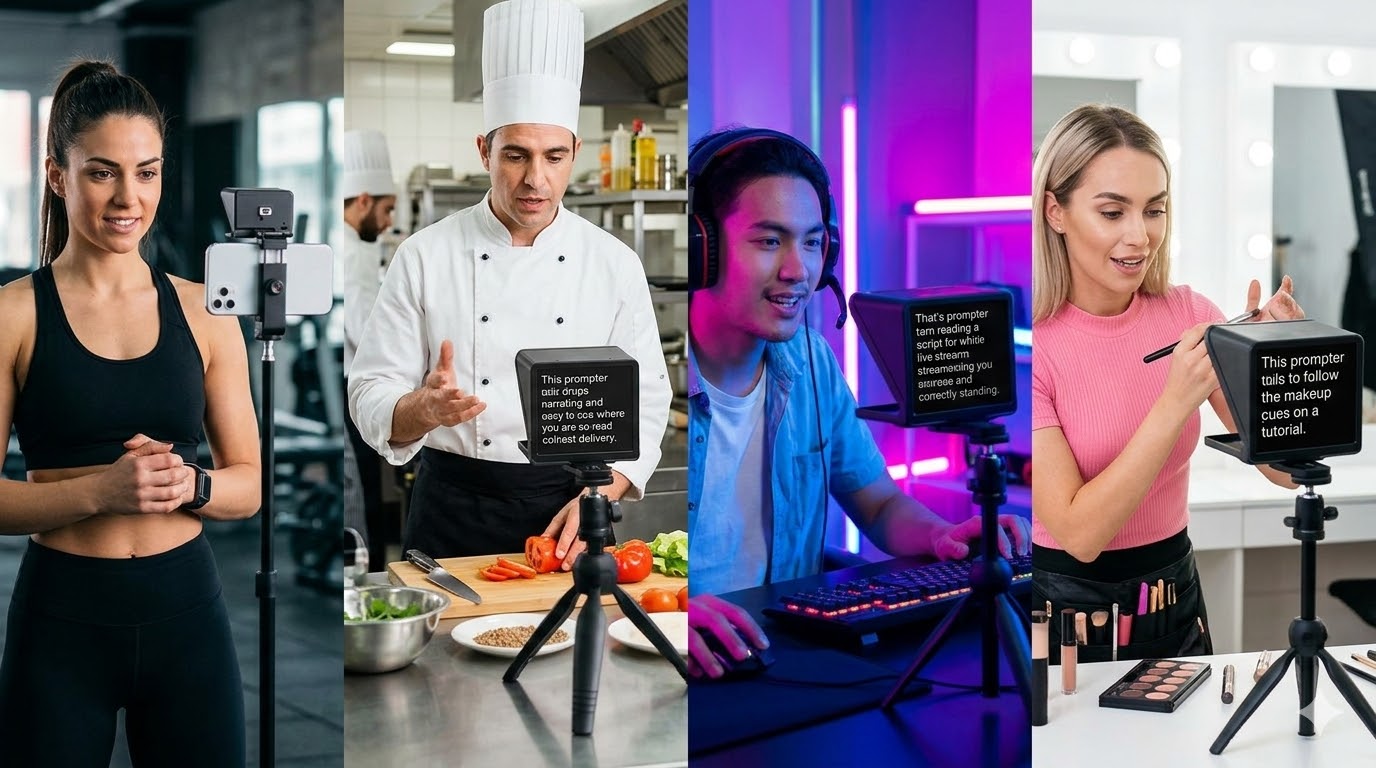
Content creators — YouTube, TikTok, Instagram, and podcast creators use teleprompters to reduce retakes, maintain eye contact with the camera, and deliver scripted content faster.
Business professionals — remote workers, sales professionals, executives, and managers use browser-based teleprompters for Zoom presentations, client pitches, and recorded communications.
One-time users — job candidates preparing for video interviews, founders rehearsing investor pitches, speakers preparing keynotes and wedding speeches — people who need a teleprompter once for a high-stakes moment.
Voice-activated scroll — the feature that changed everything
Traditional teleprompters scroll text at a constant speed set by an operator — in broadcast, a trained prompter operator adjusts speed in real time to match the presenter. In software teleprompters, the speaker sets a speed before recording and tries to match it.
The problem with fixed speed is that natural delivery is not constant. Speakers speed up during high-energy sections, slow down to let a point land, pause for emphasis. Fixed speed averages this out into metronomic delivery that sounds and feels rehearsed.
Voice-activated scroll inverts the relationship. The teleprompter software listens to the speaker's voice and advances the script automatically as they speak. The speaker's delivery drives the scroll pace — not the other way around.
This development — first implemented in software teleprompters around 2015 and now standard in leading tools — is the single biggest improvement in teleprompter usability since the beam splitter design. It is the feature that separates basic scroll tools from modern teleprompters and the primary reason teleprompter delivery no longer sounds like teleprompter delivery when done well.
Do you need a teleprompter?
A teleprompter is worth using if any of these apply:
You record video content — YouTube, TikTok, Instagram, online courses, training videos. A teleprompter reduces retakes, maintains eye contact with the camera, and allows you to deliver more content in less recording time.
You present on video calls — Zoom, Teams, Google Meet. A browser overlay teleprompter keeps your eye line on the camera throughout the presentation, which reads as confident and engaged rather than distracted.
You have an upcoming high-stakes video moment — a job interview, an investor pitch, a keynote speech, a press interview. A teleprompter gives you access to your prepared material without looking away from the camera.
You use filler words frequently when recording — um, uh, you know. These are caused by the cognitive load of recalling what to say next. A teleprompter removes this load, which removes the filler words structurally.
A teleprompter is probably not necessary if you record very short unscripted content (under 60 seconds), if you present entirely from memory without notes of any kind, or if your content is conversational and benefits from genuine spontaneity.
For everyone else, the question is not whether to use one but which type — hardware rig, native app, or browser-based — matches your use case and setup.