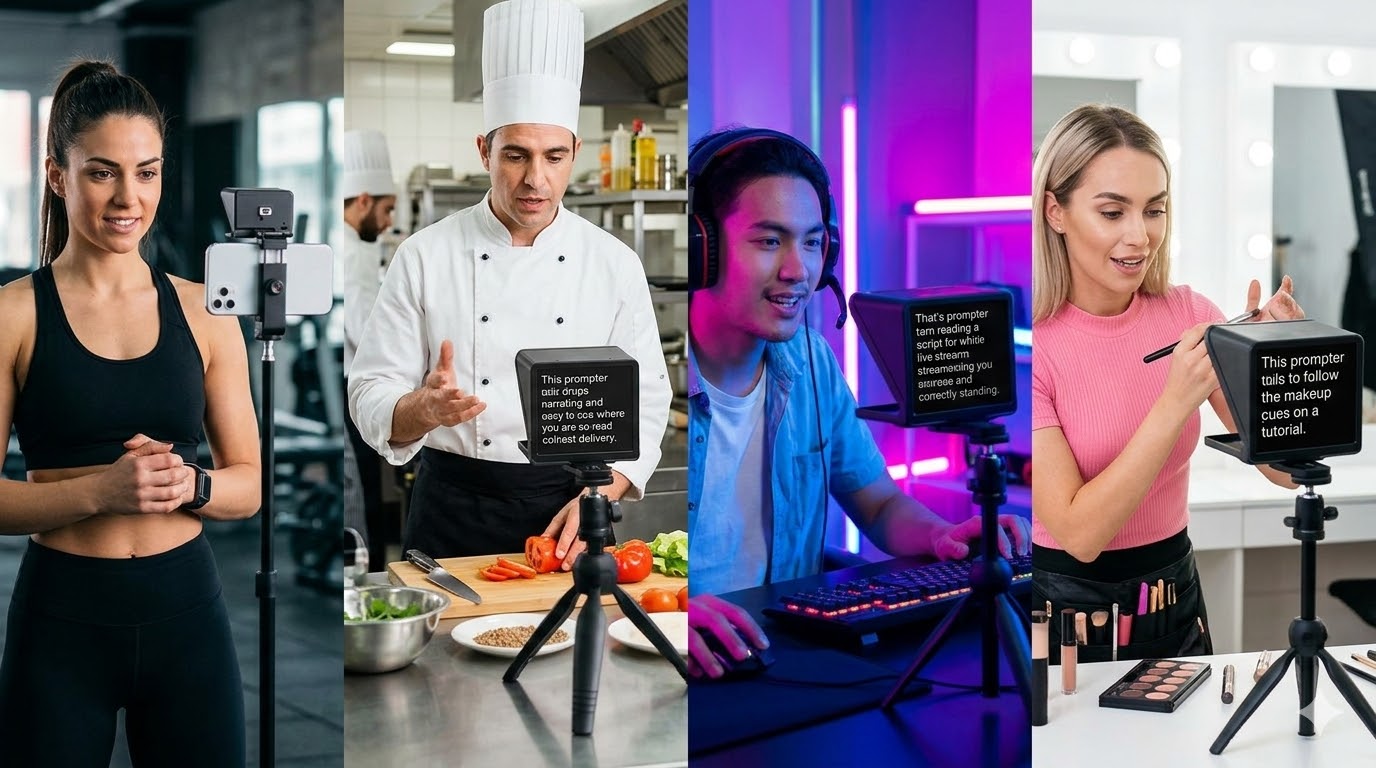
Why video prospecting with a teleprompter outperforms winging it
The argument against scripting prospecting videos is authenticity — 'I don't want to sound like I'm reading'. That's a legitimate concern about delivery technique, not scripting itself.
The reps who wing their prospecting videos consistently make the same mistakes: - They run long. A 3-minute prospecting video is a minute and a half too long. Without a script, there's no natural stopping point. - They bury the value prop. Unscripted delivery leads with context and background before getting to why the prospect should care. A script forces you to front-load. - They don't hit all the elements. Trigger event, pain point, specific outcome, CTA — winging it means you'll usually miss one.
The reps who script and use a teleprompter: - Consistently stay under 90 seconds - Always lead with the trigger or pain point - Hit every required element in every video - Sound more natural than they think, because voice scroll removes the metronomic pace that signals 'reading'
The 60-second prospecting video structure
Every high-performing cold outreach video follows a version of this structure. It fits in 60 seconds at natural speaking pace:
0–5 seconds: Name and trigger. 'Hey [Name] — saw [company] just [trigger event]. Congrats.'
The trigger should be specific: a new hire announcement, a funding round, a job posting, a recent piece of content they published. Generic openers ('I came across your profile') kill trust immediately.
5–20 seconds: Pain point connection. 'When [companies like yours / SaaS companies scaling from 50 to 200] hit that stage, the thing that usually slows them down is [specific pain point].'
Connect the trigger to a known pattern. You're showing you understand their world, not just their name.
20–45 seconds: Specific outcome. 'We helped [similar company] [specific result] in [timeframe]. Happy to show you exactly how — takes 20 minutes.'
One customer, one result, one number. Not a list of features. Not a capabilities overview.
45–60 seconds: CTA. 'If that's relevant — [pause] — I'll drop a link below. No pressure.'
Low-pressure CTAs outperform 'I'd love to connect' because they respect the prospect's time and reduce the friction of saying yes.
The teleprompter setup for prospecting videos
The specific setup matters. Most reps who try teleprompters for prospecting videos abandon them after two attempts because they sound worse, not better. The problem is always the same: fixed scroll speed.
The right setup:
Voice-activated scroll. The script follows your voice. When you say the prospect's name with genuine enthusiasm, the scroll matches your pace. When you pause for the CTA, the scroll waits. You're not chasing text — you're talking, and the teleprompter is keeping up.
Short script, large font. A 60-second script at 130 words per minute is about 130 words. In syncedcue, set the font to 36–40pt with a centred narrow column. The entire script should be visible in 3–4 scrolls, not 15. Large text means less eye movement, which means more natural eye contact on camera.
Camera at eye level above the text. Your phone or webcam should be immediately above the centre of your screen. When you read, your gaze stays near the lens axis. This is the physical reason teleprompters work for broadcast — the text is positioned directly below the camera so eye contact is maintained while reading.
One customised field per video. Don't rewrite the whole script for each prospect. Write one version with a [NAME] and [TRIGGER] field. Customise those two fields before each recording. Everything else stays consistent.
Personalisation at scale: how to batch-record 20 videos in an hour
The biggest objection to video prospecting is time. 'I can't record 50 personalised videos a week.'
The answer is batching by template, not by prospect.
Step 1: Write 3–4 script templates for your most common trigger events. Funding round template. New SDR hire template. Recent content piece template. Job posting template.
Step 2: List your prospects for the day. Group them by which template applies.
Step 3: Load template 1 in syncedcue. Change [NAME] and [TRIGGER]. Record. Review (30 seconds). Move to the next prospect in the same template group.
Step 4: When you've finished all prospects for template 1, load template 2. Repeat.
With this approach, you're recording 2–3 minutes per prospect, not 10. The cognitive load of recording drops dramatically because the structure and words are consistent — you're only personalising the variables.
The Zoom background teleprompter is especially useful for LinkedIn native video prospecting. Your script floats behind your face on camera. You record the video in syncedcue, download it, and upload it natively to LinkedIn. No one sees the script.
The delivery mistake that kills response rates
The single biggest delivery mistake in prospecting videos isn't sounding scripted. It's looking away from the camera.
Eye contact is the primary trust signal in any face-to-face interaction, and video is no different. A rep who maintains eye contact with the camera while delivering a scripted message is more trusted than one who wings the message while glancing around.
The teleprompter fixes this — but only if it's positioned correctly. If the text is offset to one side, or displayed on a separate device from your camera, your eyes will drift off-axis and the eye contact is broken.
The syncedcue Zoom background teleprompter solves this architecturally. The script is rendered behind your face on camera. Your camera lens is at the top of your screen. When you read the script in the background of your own camera feed, your gaze is aimed at the lens. The eye contact is built into the setup.
This is the setup professional broadcast anchors use. The reason they look like they're talking to you directly is that the text is physically between them and the lens. You can replicate this in a browser.