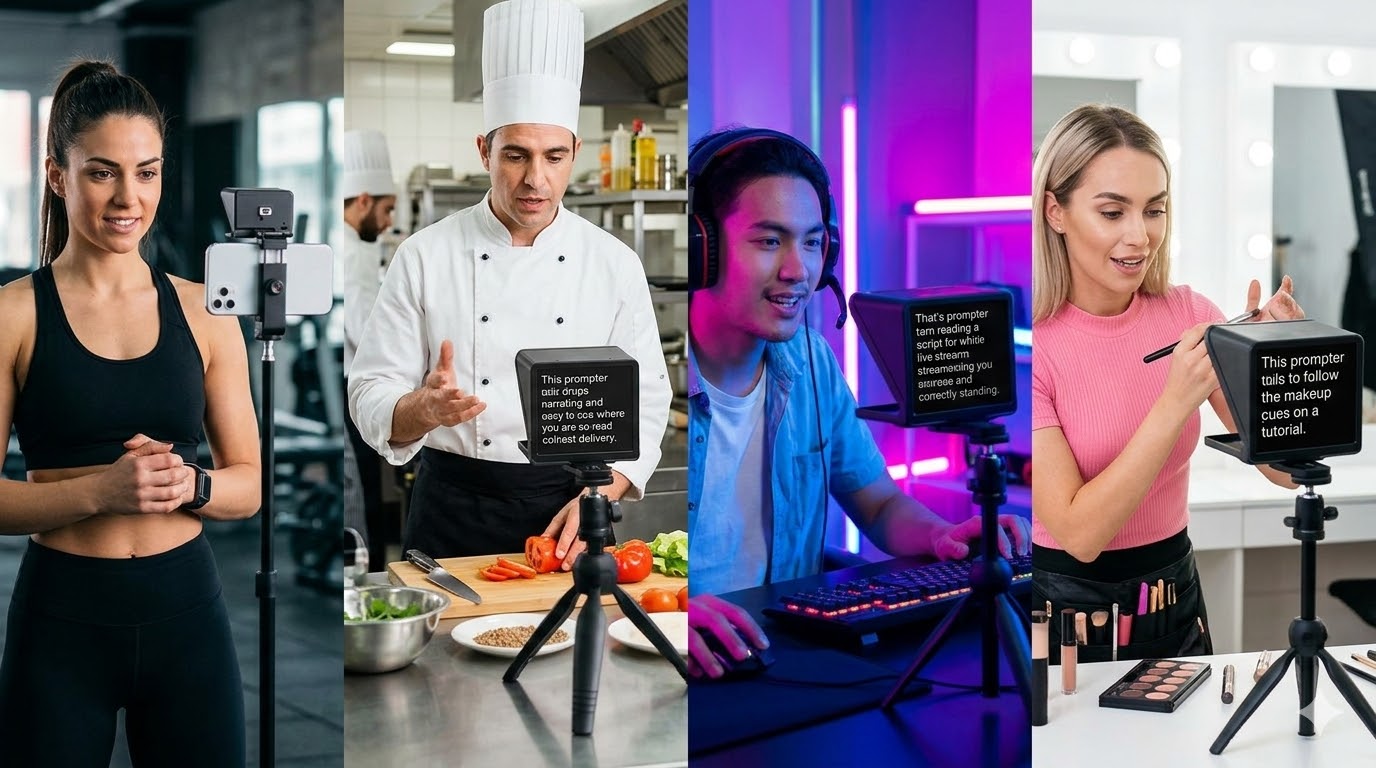
The setup problems that make you look unconfident regardless of how you feel
Before addressing delivery, address setup. The physical environment your camera captures determines how confident you look before you say a single word. Three variables matter most.
Camera height.
This is the highest-impact single change available to anyone who presents on video. Most laptops sit on desks with the camera at chest height or below. The result is a camera angle looking up at you — which creates a downward gaze angle from your eyes to the lens. You look down to see your screen. You look down to check notes. The camera, which is below your natural eye line, captures this downward angle continuously.
Raise your laptop or webcam until the camera is level with your eyes or one to two inches above. Now looking at the screen — looking at the faces of the people you are talking to — and looking at the camera are the same direction. Your eye line is forward or slightly upward, which reads as engaged and direct.
A stack of books, a laptop stand, or a monitor arm accomplishes this. It takes two minutes and the visual difference is immediate and significant.
Light direction.
A window or bright light source behind you makes you a silhouette. Your face is underexposed, your features are unclear, and the high contrast background draws visual attention away from you. This is not an aesthetic problem — it is a clarity problem. Viewers who cannot clearly see your face cannot read your expressions, which reduces the emotional engagement that makes communication feel confident and trustworthy.
Move so that the light source is in front of you — a window you face rather than one behind you, a desk lamp positioned above and in front of your camera. The light should come from the same direction as the camera so your face is evenly lit without harsh shadows.
Background.
A cluttered background divides attention. Viewers' eyes track movement and visual complexity behind you — a busy bookshelf, an open door with activity behind it, a pile of laundry in the corner of frame. Each visual element behind you competes with your face for attention.
Either clear the area behind your chair to a visually simple background, use a plain wall, or use a Zoom virtual background. The goal is not aesthetics — it is removing competition for the viewer's attention so your face and delivery carry it completely.
Eye contact — the primary credibility signal and how to maintain it
In a physical conversation, eye contact is distributed — you look at one person, then another, glance away to think, return to the speaker. The social norm is fluid and forgiving.
In a video call or recorded video, there is one camera and one eye contact target. Looking at the camera is the equivalent of looking directly at every viewer simultaneously. Looking away from the camera — at notes, at other windows, at your own face in the corner of the screen — is the equivalent of breaking eye contact with every viewer simultaneously.
This asymmetry is why eye contact matters so much more on video than in person. Every break is felt by everyone at once.
The three things that break camera eye contact most often:
Notes on the desk. When your reference material is below the camera, looking at it requires a visible downward movement. Every note check is a break.
A second monitor beside the camera. Looking at a second screen to check slides, data, or talking points moves your eyes horizontally away from the lens. The movement is less obvious than looking down but still registers.
Your own face in the video call interface. The small thumbnail of yourself in the corner of the Zoom window is surprisingly compelling — the instinct to monitor your own appearance pulls your eyes away from the camera constantly. Move your self-view thumbnail next to the camera in your screen layout to reduce this, or hide self-view entirely.
The fix that addresses all three:
Zoom background overlay positions your teleprompter script in direct camera line of sight. Reading the script and looking at the camera are the same direction. Notes on desk — eliminated. Second monitor — unnecessary. Self-view thumbnail — irrelevant because you are not looking away regardless.
For recorded videos, positioning the teleprompter display at camera level — either through a beam splitter hardware rig or through the overlay method — produces the same result.
Filler words — the cognitive load problem and the structural fix
Filler words are the most audible signal of unconfident delivery. Viewers register them consciously — unlike eye contact drift or inconsistent pacing, which register subconsciously — and they create a specific impression: the speaker does not know what they are going to say next.
This impression is usually correct. Filler words fill the cognitive gap between finishing one thought and beginning the next. When you know exactly what comes next — when the next sentence is already formed and available — there is no gap to fill. The filler word has no moment to appear.
Most advice about filler words treats them as a habit to suppress — practice pausing instead of filling, record yourself and count the ums, build awareness. This approach requires constant conscious effort during delivery, which itself creates cognitive load, which creates more filler words.
The structural fix is simpler: remove the cognitive load that produces them.
A teleprompter with voice scroll removes the 'what comes next' requirement entirely. The next sentence is visible on the screen. You read it, the scroll advances, the next sentence appears. The mental space previously occupied by real-time recall is available for delivery — for pace, for emphasis, for responding to the room.
The result is not just fewer filler words. It is a quality of delivery that sounds considered rather than improvised — because the consideration happened during script writing, not during the recording or presentation.
Pacing — the confidence signal most people get wrong
The instinct under pressure is to fill silence. When you finish a sentence and the next thought is not immediately available, anxiety fills the gap — with a filler word, with a rushed continuation, with a circular restatement of the previous point.
Confident on-camera delivery does the opposite. It uses silence deliberately.
A pause before a key point signals that what follows is important. Viewers lean in. The absence of words creates a moment of anticipation that makes the words that follow land harder than they would if the delivery were continuous.
A pause after a key statistic or claim gives viewers time to process it. Without the pause, the next sentence arrives before the previous one has landed and both are diminished.
A pause before a call to action — before asking for the sale, before stating the recommendation, before naming the price — creates gravity around what follows. Rushed CTAs feel desperate. Paused CTAs feel certain.
None of this requires a teleprompter to execute. But a teleprompter with explicit pause markers in the script — '[pause]' written at every point where silence should appear — makes it consistent. Without markers, the instinct to fill silence reasserts itself under pressure and the pauses disappear. With markers, the script instructs the pause and voice scroll waits for you to resume.
The practical rule for pacing: if you think you are speaking slowly enough, speak slower. Almost every on-camera speaker who reviews their own footage discovers they spoke faster than they perceived. The pace that feels uncomfortably slow in delivery sounds natural and authoritative on playback.
Energy consistency — why confident speakers do not fade
A confident opening is easy. Adrenaline is high, the prepared words are freshest, the audience is most attentive. Most speakers deliver their first two minutes well regardless of overall preparation level.
The middle is where confidence signals diverge.
Speakers who prepared only the opening — who have talking points or bullet notes for the middle rather than a full script — begin reconstructing in real time as the prepared material runs out. The delivery slows fractionally. The sentence structure becomes less clean. Eye contact drift appears as notes are consulted. Energy drops as cognitive load rises.
Viewers do not consciously identify 'prepared material has run out.' They feel a diffuse drop in engagement — the speaker seems slightly less present, slightly less certain. This is what 'fading' looks and sounds like, and it reads as unconfidence even when the content of the middle section is good.
A full script with explicit section markers maintains preparation throughout. Not necessarily word-for-word for every section — structured bullet prompts work well for middle sections — but enough that every section has a clear entry point, clear key points, and a clear transition to the next section.
Energy markers in the script reinforce this. Write '(energy up here)' before a high-engagement section. Write '(slow down — let this land)' before a key statistic. Write '(pause before the ask)' before the close. These notes are not in the final delivery — they are instructions to yourself, visible on the teleprompter, that keep delivery quality consistent across the full length of the presentation or recording.
The preparation framework — what to prepare and how
The goal of preparation for on-camera delivery is not to memorise your material. Memorisation produces two failure modes: robotic delivery when it works, and complete loss of place when a distraction interrupts the sequence.
The goal is structured familiarity — knowing the shape of what you are going to say, the key points in each section, the specific details and numbers that matter, well enough that delivery is fluent without requiring word-for-word recall.
Here is the preparation framework that produces this:
Step 1: Write a full script. Start with a template that matches your use case — presentation, YouTube video, job interview, pitch — and fill in the specific substance. Writing forces clarity. Ideas that seem clear in your head often become vague when written out. The script-writing process is the first pass at finding and fixing these gaps.
Step 2: Read the script aloud and rewrite anything that does not sound like you. A script written for the eye sounds different spoken aloud. Formal constructions, long sentences, words you would not use in conversation — these all become apparent when spoken. Rewrite until every sentence sounds like your natural speaking register.
Step 3: Run it once with voice scroll, not to memorise — to calibrate. Enable voice scroll and run the script once at delivery pace. You are checking: does the scroll feel natural? Are there sections where the energy drops? Are there sentences that still trip your tongue? Fix what you find.
Step 4: Record one practice take and review it. Record yourself delivering the script and watch it back. Look for: eye contact consistency, pacing variation, filler words, energy consistency through the middle. Make two targeted fixes based on what you see — not a full rewrite, two specific improvements.
Step 5: Deliver. The goal of preparation is to reach the delivery moment with enough familiarity that your attention is on the audience rather than on your own material. When you know the shape of what you are going to say, you can respond to the room — to a laugh, to a question, to a moment of confusion — without losing your place. That responsiveness is what confident delivery looks like from the outside.
The one tool that addresses setup and preparation simultaneously
Setup and preparation are usually treated as separate problems requiring separate solutions. Camera height is a setup problem. Filler words are a preparation problem. Eye contact is partly both.
A browser teleprompter with Zoom background overlay and voice scroll addresses both simultaneously.
At the setup level: The overlay positions your script in direct camera line of sight. Eye contact is maintained structurally — not through conscious effort, but because reading and looking at the camera are the same direction. The setup problem is solved before the recording starts.
At the preparation level: A full script removes the cognitive load of real-time recall. Voice scroll removes the constraint of fixed speed. The combination means your mental attention during delivery is on pace, emphasis, and audience response — not on what comes next.
The practical result: the two most visible signals of unconfident delivery — eye contact drift and filler words — are addressed structurally rather than requiring continuous conscious management during delivery.
This matters because conscious management competes with delivery. Trying to maintain eye contact while also thinking about what comes next while also managing your pace while also reading your audience is too many concurrent tasks for most people under pressure. Removing two of those tasks — eye contact (handled by the overlay) and what comes next (handled by the script) — leaves your attention available for the tasks that actually require it: pacing, emphasis, and response.