What teleprompter hardware actually does — and does not do
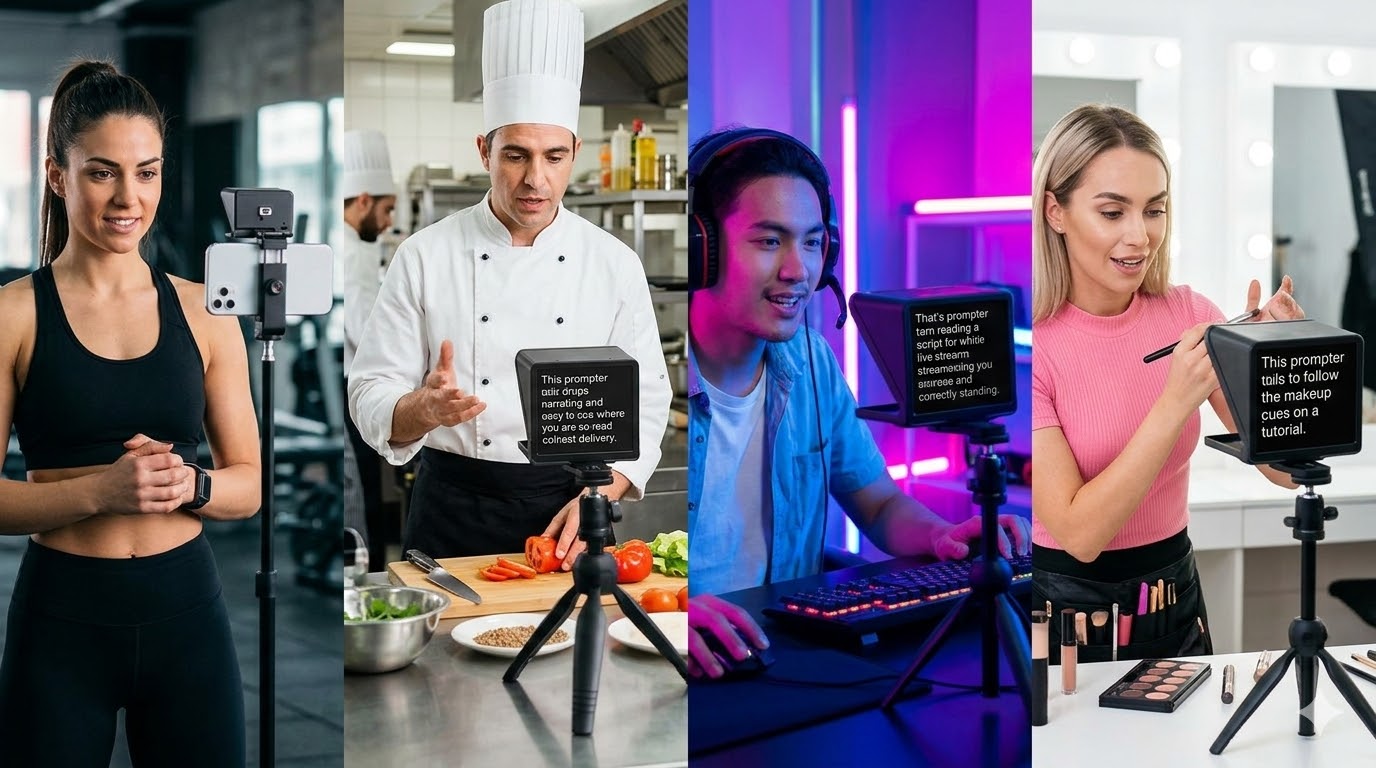
A teleprompter is mechanically simple. A half-silvered mirror mounted at 45 degrees in front of a camera lens reflects a screen positioned beneath it. The presenter reads the reflected text while looking directly into the lens. The camera shoots through the mirror without capturing the reflection.
Every rig from a $40 phone clamp to a $2,000 broadcast unit does this same thing. The differences between hardware tiers are:
Eye-line accuracy: Cheaper rigs position the text slightly off-center from the lens. For wide lenses (below 35mm), the offset is visually negligible. For tight focal lengths (85mm and above), it can appear as a slight gaze offset on camera.
Glass quality: Better mirrors handle direct sunlight without washing out and show less reflection distortion. For indoor use, the difference between $40 glass and $200 glass is marginal. For outdoor shoots in direct sunlight, it is significant.
Build quality and setup time: Budget rigs take longer to assemble, feel less stable, and require more adjustment between takes. Professional rigs are faster to set up and more consistent between sessions.
What hardware does not affect: How natural your delivery sounds on camera. That is determined entirely by the software — specifically whether it uses fixed-speed scroll or voice-activated scroll.
Beginner teleprompter options by budget
$0 — use what you have: Any monitor, tablet, or phone propped below or beside the camera lens works as a basic teleprompter. The eye-line will be visibly off, but for practice and low-stakes recordings it is a valid starting point. Pair with SyncedCue in any browser for voice scroll at no cost.
$40–70 — phone clamp rigs: A beam-splitter glass mounted to a clamp that holds a smartphone as the display. The Desview T3 is the most widely reviewed option in this range. These rigs work well for smartphones and mirrorless cameras with kit lenses. Setup takes 5–10 minutes. Glass quality is acceptable for indoor use. This is the correct entry point for most beginners.
$80–120 — the Neewer X11: The best step-up from basic phone clamps. Better glass alignment, sturdier mounting, and a larger display area than budget options. First-time users consistently report the setup as more approachable, with text comfortably readable at normal filming distances. For beginners who want hardware that will not frustrate them through the learning period, this is the recommendation in this tier.
$200–300 — the Elgato Prompter XL: A different hardware category entirely. The Elgato Prompter XL is a monitor-based teleprompter for desk use — it replaces an existing monitor and displays the script on a built-in screen in front of the lens. There is no mirror assembly to set up. It connects via USB-C to PC or Mac. For creators filming at a desk for YouTube, Zoom, and business video, this is the most elegant consumer hardware solution available. It is not portable and it is not a camera rig teleprompter. For its specific use case, it is the best option.
$400+ — professional rigs: Larger glass panels, motorized stand adjustments, tablet-sized displays, weatherproof builds. Appropriate for broadcast production and event video. Not appropriate for beginner YouTube or business video. Save the money.
The software decision matters more than the hardware decision
Every teleprompter app falls into one of two categories: fixed-speed scroll or voice-activated scroll.
Fixed-speed scroll moves the text at a constant words-per-minute rate you set before recording. To stay in sync, you unconsciously match that rate throughout the script. Every section is delivered at the same pace — the energetic hook at the same speed as the considered recommendation. This is the primary cause of teleprompter delivery sounding robotic and obviously scripted.
Voice-activated scroll listens to your voice and advances the text as you speak. When you speed up, the scroll speeds up. When you pause, the scroll stops. You set the pace — the teleprompter follows. Your natural variation in delivery pace is preserved rather than averaged out.
For beginners, this distinction matters more than any hardware feature. A first-time user on fixed scroll will almost always sound scripted. The same person using voice scroll will sound significantly more natural within a few takes, because the scroll adapts to their delivery rather than forcing them to adapt to it.
SyncedCue includes voice scroll and runs on any device with a browser — it pairs with any hardware rig. The hardware choice and software choice are entirely independent.
What to expect from your first recording session
The first take with a teleprompter is almost always worse than speaking without one. This is expected and temporary.
Reading from a teleprompter for the first time requires three new cognitive tasks simultaneously: reading the text, staying synchronized with the scroll, and performing naturally for camera. Performing naturally while managing the other two takes practice. Most users find delivery normalizes within 3–5 takes of the same script.
Three things accelerate this process:
Use voice scroll from the first take. The temptation is to start with fixed scroll at a slow speed because it feels more controllable. It is not — it is more constraining. Voice scroll removes the synchronization task entirely. You speak at your natural pace and the teleprompter follows. Start with voice scroll.
Do a read-through before recording. Run the full script with the teleprompter running before recording any takes. This warms up voice scroll's calibration and removes the cognitive load of reading the words for the first time during a recorded take.
Write scripts that sound like how you speak. Teleprompters deliver the words you wrote — they do not make formal prose sound conversational. Short sentences, active voice, and natural contractions are easier to deliver naturally. Read every line aloud before recording. Any sentence you would not say in a normal conversation should be rewritten.
Script length reference: words by video duration
Use this before writing to avoid scripts that run long or short on camera.
30 seconds: 110 wpm: 55 words | 130 wpm: 65 words | 150 wpm: 75 words
1 minute: 110 wpm: 110 words | 130 wpm: 130 words | 150 wpm: 150 words
3 minutes: 110 wpm: 330 words | 130 wpm: 390 words | 150 wpm: 450 words
5 minutes: 110 wpm: 550 words | 130 wpm: 650 words | 150 wpm: 750 words
10 minutes: 110 wpm: 1,100 words | 130 wpm: 1,300 words | 150 wpm: 1,500 words
Practical note: Run a timed read-through in SyncedCue before recording to validate your script length at your actual delivery pace. The countdown timer shows whether the script will hit your target duration before you record the final take.